CMMC Level 2 consulting

Defense contractors that handle federal contract information or controlled unclassified information (CUI) are assessed under CMMC, the Cybersecurity Maturity Model Certification. Our engineers join your team, in your tenants and on your equipment, and stay through the assessment itself.

The engineers who score your gaps also close them, under your policies. The readiness assessment takes four weeks from kickoff to a defensible baseline.

The Cyber AB RPO badgeCMMC Registered Practitioner Organization (opens in a new tab)

Phase 2 suspended

A Department of War (DoW) task force is reviewing CMMC. Phase 1 still applies: self-assessments and annual affirmations.

Example: POA&M item3.13.11

Day 47 of 180

Employ FIPS-validated cryptography when used to protect the confidentiality of CUI.

Subtracts 3 points, not 5: encryption in place, not yet FIPS-validated

A Conditional Level 2 status gives 180 days to close each POA&M item. This one is on day 47.

Score the 110 Level 2 requirements

Select a requirement to read it as written, and mark whether you meet it. The score and the status it supports follow 32 CFR 170.24 and 170.21.

NIST SP 800-171 Rev. 2, the source of the 110 requirements. NIST withdrew it in May 2024 for Rev. 3; CMMC Level 2 still uses Rev. 2.
Level 2 self-check32 CFR 170.24 and 170.21

Score110110 − 0

You start at 110. Mark the requirements you have not met to see your score.

Not met (0)

None. Select a requirement in the map and mark it.

An estimate from your own marks, which stay in this tab until you close it and are never sent to us. Your assessor scores each requirement’s objectives, and that score is the one that counts.

ACAccess Control22

ATAwareness and Training3

AUAudit and Accountability9

CMConfiguration Management9

IAIdentification and Authentication11

IRIncident Response3

MAMaintenance6

MPMedia Protection9

PSPersonnel Security2

PEPhysical Protection6

RARisk Assessment3

CASecurity Assessment4

SCSystem and Communications Protection16

SISystem and Information Integrity7

Identification and Authentication (IA)

3.5.3

Use multifactor authentication for local and network access to privileged accounts and for network access to non-privileged accounts.

If not met 5 points, or 3 if MFA covers remote and privileged users only. It cannot go on a POA&M.

Your status for 3.5.3
Score 110

How the score works

The score
You start at 110. A requirement not met subtracts its value under 32 CFR 170.24, which is 5 or 3 points for the requirements the rule names and 1 point for the rest.
Partial credit
Two requirements can be partially effective. MFA (3.5.3) in place for remote and privileged users only subtracts 3 points instead of 5, and so does encryption of CUI (3.13.11) that is in place but not FIPS-validated. What FIPS 140-2 modules going historical means
The System Security Plan
Requirement 3.12.4 has no point value. Without an up-to-date SSP at the time of assessment, the rule says the assessment could not be completed.
What it does not do
It does arithmetic on your marks. The assessor scores the assessment itself, objective by objective.

Text from NIST SP 800-171 Rev. 2 (opens in a new tab), Chapter Three. The CMMC rule is 32 CFR Part 170 (PDF, opens in a new tab); contracts carry it through DFARS 252.204-7021 (opens in a new tab). SP 800-171 itself reaches a contract through DFARS 252.204-7012, 7019 and 7020.

What counts as in scope

We trace where Federal Contract Information (FCI) and controlled unclassified information (CUI) are processed, stored and transmitted, and find the systems that protect them.

CMMC assessment scope

CMMC assessment scope: select a technology layerAn example architecture in three selectable layers: Software and SaaS, the applications handling CUI and the identity services; Resources, the compute and databases behind them; and Infrastructure, the systems hosting them. Select a layer to read what an assessment looks at.The host infrastructure under the workload, which the boundary documentation has to account for.The compute and database behind the application: how they process or store CUI, and who can reach them.Applications that handle CUI, and the services that protect access. Here the identity service protects CUI without storing it.

Software & SaaS

Applications that handle CUI, and the services that protect access. Here the identity service protects CUI without storing it.

  • Applications handling CUI
  • Identity and access controls
  • Supporting services and dependencies

CUI: controlled unclassified information. Example layers; your boundary is drawn for your system.

Level 1 for Federal Contract Information

Contractors that handle Federal Contract Information but no CUI assess themselves every year against the 15 requirements of FAR 52.204-21. Each must be met in full, since Level 1 allows no POA&M, and a senior official affirms the result in the Supplier Performance Risk System (SPRS). The evidence is kept for six years.

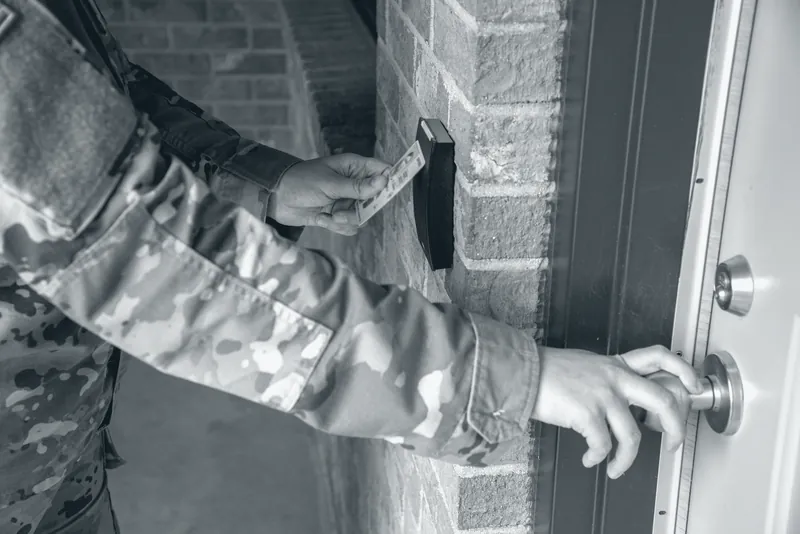
A hand holds a government smart card up to a card reader on a brick wall beside a door, while the other hand opens the door.
A Common Access Card held to a door’s card reader at Peterson Space Force Base, Colorado. The reader’s light turns green and the door unlocks.Photo: U.S. Space Force photo by Airman 1st Class Brooke Wise, via Wikimedia Commons (opens in a new tab)

SP 800-171 equivalents of the 15 requirements

One of the 15, on visitors and physical access devices, maps to three SP 800-171 requirements, so the list has 17.

  • 3.1.1
  • 3.1.2
  • 3.1.20
  • 3.1.22
  • 3.5.1
  • 3.5.2
  • 3.8.3
  • 3.10.1
  • 3.10.3
  • 3.10.4
  • 3.10.5
  • 3.13.1
  • 3.13.5
  • 3.14.1
  • 3.14.2
  • 3.14.4
  • 3.14.5

Requirements from FAR 52.204-21(b)(1) (opens in a new tab); equivalents and the annual cycle from 32 CFR 170.15 (opens in a new tab).

Assess, advise, engineer and prepare

Assess

We score each in-scope requirement against your environment as it is today and write down why we took points off. Where you grant admin access, we verify what is enforced.

Readiness assessment report
A finding and recommendation for every technology in the boundary.
Boundary and data-flow diagrams
Systems, information flows and the services that protect them, drawn so your SSP can be written from them.
Prioritized remediation roadmap
Findings by quarter, with effort, owners and resourcing.
Executive summary and presentation
Your posture, its business impact and the decisions leadership has to make, in a deck your team can present without reworking it.
Readiness finding
Requirement
3.5.3 Multifactor authentication
Status
Partially met
Rationale
MFA is enforced for network access. Local access to privileged accounts is not yet covered.
Owner
IT operations
Effort
Medium
Target quarter
Q2
An example. Statuses are our readiness terms; only an assessment gives a CMMC result.

Advise

We write the documentation an assessor will ask to see, from the environment we assessed.

  • System Security Plan
  • Policies and procedures
  • Customer responsibility matrix (CRM)
  • Assessment inventories

What a Registered Practitioner Organization does

The Cyber AB registers companies that provide CMMC implementation consulting as Registered Practitioner Organizations (RPOs); some of its pages call them Registered Provider Organizations. Their Registered Practitioners help a contractor find its gaps and plan how to close them before an assessment.

Check the listing
The Cyber AB lists each RPO in its Marketplace once its registration, which includes a background check, is complete. Automata’s listing (opens in a new tab)
Keep the consultant and the assessor apart
The CMMC rule bars anyone in the CMMC ecosystem from taking part in a company’s Level 2 certification assessment if they consulted to prepare it for a CMMC assessment in the previous three years.

What a CMMC assessment costs

The CMMC rule estimates what each assessment costs a small business, including an outside consultant’s hours. It leaves out the cost of meeting the requirements, which FAR 52.204-21 has required since June 15, 2016 and DFARS 252.204-7012 since December 31, 2017.

The CMMC rule’s cost estimates for a small business
AssessmentHow oftenEstimated cost
Level 1 self-assessmentEvery year, with an affirmation$5,977
Level 2 self-assessmentEvery three years, with an affirmation each year$34,277, or $37,196 over three years
Level 2 certification assessment by a C3PAOEvery three years, with an affirmation each year$101,752, of which $31,234 is the C3PAO’s, or $104,670 over three years

Estimates from the CMMC rule’s regulatory impact analysis, 89 FR 83092, October 15, 2024 (opens in a new tab). It estimates more for larger companies: $112,345 for a Level 2 certification assessment.

Before your CMMC assessment

Is CMMC Level 2 a self-assessment or a C3PAO assessment?
Your contract decides. Level 2 can be met through a self-assessment or a C3PAO certification assessment. While Phase 2 is suspended, DoW says CMMC may only require the self-assessment.
Can we pass with open POA&M items?
Yes, under conditions. You need a score of at least 88 out of 110, and the open items must be one-point requirements, with a narrow exception for CUI encryption that is not FIPS-validated. Six requirements, the System Security Plan among them, cannot go on the POA&M. The closeout assessment has to happen within 180 days.
What does Level 3 add?
It adds 24 requirements selected from NIST SP 800-172, and DCMA DIBCAC assesses them. You need a Final Level 2 (C3PAO) status for the same assessment scope first.
Are our security tools in scope?
Yes. Security protection assets are in the assessment scope. Those are the systems that protect CUI, even when they don’t store it.
Does the Department of War name change CMMC?
No. Department of War became a secondary title for the Department of Defense on September 5, 2025. That does not amend the CMMC rule in 32 CFR Part 170.
Is Automata registered with The Cyber AB?
Yes. Automata is a Registered Practitioner Organization (RPO), listed in The Cyber AB’s CMMC Marketplace. An RPO advises on CMMC. It does not conduct certification assessments; a C3PAO does.
How long does readiness take?
Four weeks from kickoff to a defensible baseline. After that, remediation and the certification assessment follow the plan we agree with you.

Score your 110 requirements, then book the readiness assessment